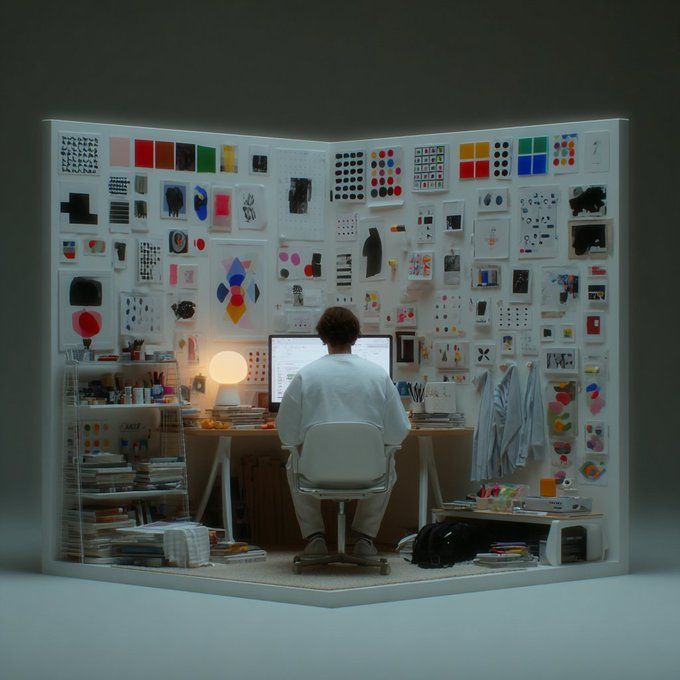
level up!
“A woman must have money and a room of her own if she is to write fiction.”
The quote ran through my mind as I tiptoed over the slew of boxes landmining my bedroom floor. My head pounded at the sight of pillows strewn across the undressed mattress; the veins in my forehead throbbed at the mystery boxes waiting to be unpacked by the room’s only exit. An absolute clusterfuck of clothes and shoes heaped on my desk chair—a graveyard of thrift finds and impulse buys—left me paralyzed, wringing out my hands while staring at it in a daze.
I’m no germaphobe, but theres’s a neat freak in me that comes out when my living space is disorderly. “Tidy desk, tidy mind,” right?
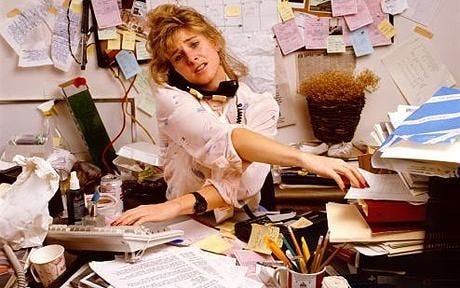
I wasn’t frustrated so much by the labor of unpacking both my LA and New York apartments at once (I kind of loved the challenge of it, actually), but rather that in the time I did carve out from the chaos for creativity, there wasn’t even chalk at the blank slate. At first, I blamed the friction grating against my ADHD-ladeled frontal lobe, something about dopamine pathways priming me for distraction in an environment as hectic as my mid-move bedroom.
Yes, yes, that’s it, I thought, pacing the room’s only square foot of visible floor space. I can’t be expected to create anything meaningful right now! Look at the state of my space!
The excuse’s logic:
Premise 1: My room was hoarderish enough to be reasonably considered “messy.”
Premise 2: Messy rooms hinder meaningful creative work.
Conclusion: My room is messy, so I cannot create meaningful creative work.
The first premise I’ll give; though I wasn’t quite at the “my own Hoarders episode” stage, I was getting close. My shelves overflowed with dusty book jackets and years-old swap meet trinkets. Just one more push, I thought, sweating, then you can take a break to create.
That crowning push tore me end-to-end, but after another hour or so of physical labor I’d finally cleared off my bed enough that I could sleep in it that night and gave myself permission to call it a day.
Here’s where the frustration kicked in, though: all that creative currency I was so eager to cash in had depreciated. I clamored over to my computer to finally begin clacking away, but alas! the words did not come!
I slouched back, exhausted, and stared at the blank page like a zombie. Flat and thrown off-balance by the move and the writers’ block, I started to think through ways other than Google Docs for me to engage with my creativity: I had at my disposal some colored pencils, a fresh-off-the-conveyor-belt ceramics kit, and there was a literal pen and book sitting right next to my laptop.
If I’m being generous, it took 30? seconds for me to abandon course and start making a daily to-do list (my favorite form of procrastinating). I pulled a notebook out of my bag and held it close to my chest, as if skin-to-paper contact would make all the work in front of me doable.

But it didn’t, and here’s why: I was falsely correlating the aesthetics of the space I was in with its generative potential. I assumed that a space feeling “yours” is a necessary condition of creating, and that by cleaning my room instead of writing my Substack post I was doing something in service of my art…by avoiding my art.
Yeah, paradoxical, I know. But recognizing our cognitive dissonances is the first step to resolving them—and sitting with all those juicy emotions may actually be the thing that helps you move on to something new, something you’ve been wanting to try, a source of connection, perhaps, something that will actually make you happy. Happy, not just from fitting in or having a bout of fleeting fun, but happy at your core; fulfilled, maybe, is a better word for it.
All this to say, the spaces we’re in do affect the art we create. Too much outside noise and your brain might not have the resources to push past distraction; not enough stimulation and you might be overwhelmed with your own thoughts. Come from a low socioeconomic household and be unable to afford being able to spend time creating, at all, plus, our environments shape what we’re actively thinking about thanks to the recency effect. This effect states that the content of our creative outputs are biased towards the stimuli they’ve most recently experienced—most likely, objects in the current environment.
But even though our environments have an influence on the way we think and create, it is still our responsibility to not allow our outputs to be dictated entirely by outside factors. We must acknowledge that there will never be the perfect time or space to create. Art can only ever approach capturing the moment we are in, so a major part of the project of creating is capturing that moment—which is always shifting—fully and completely (even in all its non-condusiveness).
But the concept of ‘space’ isn’t just limited to the physical spaces we take up: it’s not just where you’re creating, but also every other element of your present lived experience (e.g. emotions, mental wellness, social bonding, physiological function). There are too many dimensions to name; but the Litmus test for if something is part of the space you’re in can be summarized in a single question:
“Does this represent a specific quality of how I am embodying myself?”
If the answer is yes (which, let’s be honest, it probably will be), then it’s part of your space and therefore within your realm of responsibility to control (whether or not you actually need or try to). Our conscious perception is a fleeting feeling, and the expanded definition of “space” as any element of one’s internal or external life—e.g. the people you’re with, what you’re thinking and your baseline mood, why you’re creating—represents a specific quality of how they are embodying themselves. This raises a a cynical (though hopefully productive) retort: if our space influences the quantity and quality of our work, everything is part of our space, and our space needs to be “right” in order to create, how do you know when a space is good enough to create in it? In this perfectionistic model of space, isn’t creating just an endless loop of “can’t until”s, “I’ll start tomorrow”s, “it’ll be okay to skip just this once”s?
This is where the crucial nuance comes in. Yes, wanting your creative space to be as supportive as possible to your practice is valid, because our space and all its elements affect what we put on the page, but trying to perfect your space in pursuit of the “best possible” creative output is ineffective and, frankly, boring. Ineffective because you’ll spend so long adjusting your desk chair that you’ll never actually get a word on the page, and boring because the environment’s perpetual influence on art is also what makes it so beautiful: its capacity to hold more than the sum of its parts. Part of the creator and their surroundings is captured in between the lines of their work, regardless of the medium. It provides us insight into how the artist experiences and relates to the world around them. It proves that we do not exist in isolation.
In his 1868 Conclusion, philosopher Walter Pater writes,“For art comes to you proposing frankly to give nothing but the highest quality to your moments as they pass, and simply for those moments’ sake.” Those moments’ sake—time here acts as a self-contained unit of being that takes on an identity of its own, deserves respect as an autonomous agent. (Which, in some ways, it does. The one thing that’s true about time is that it will always keep ticking, no matter how much we may try to interfere.) Creativity is about reciprocity, then; the moment acts outside of your control, but gives you back control by allowing you to represent it. If we want to get closer to the world, we just have to seize the opportunity to connect with it right in front of us—through our art.
It is impossible to get all domains of your physical and nonphysical spaces aligned with your creative flow. Brainstorm-maxxing? Not a thing.
But we must commit to creating even when our spaces are not conducive to it. The hardest part of creating isn’t the actual art, it’s pushing yourself past your boundaries to accept that not everything you produce is going to be your best work—so it’s okay to put something out there that’s been sullied or changed by the environment it was created in because you still created it. That is an accomplishment in and of itself. It proves dedication, willpower, and the genuine desire to want to create for the sake of it; that you are committed to representing the world as you see it, even when it’s not as rose-tinted as you like; that you had the integrity to respect your space enough to create in it.
Cultivate a space that brings out your most authentic self, but treat that space as a relationship to explore rather than a place to conquer. Leave when you’re feeling annoyed—you need time to cool off before taking up this space. Decorate and clean your space to make it feel more like your own. Your space should scream “WELCOME!” the moment you walk in the door. Relocate to a new city, try out a different medium, experiment with routines and create with the intention of representing how the world shows up to you that day. Be truthful and kind to yourself, your space, and the future you who wants you to do better NOW! Don’t create when the time is right, the lighting is perfect, the page uncrinkled; take the imperfections and own them. It’s what’s going to make your readers feel seen and, more importantly, what’s going to make you feel most fulfilled in your craft.
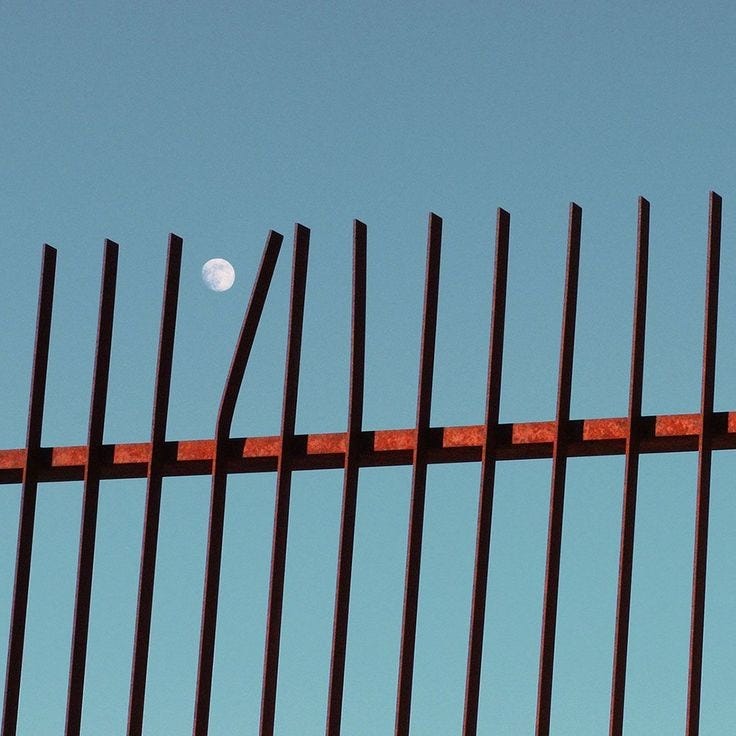
That’s the real takeaway here—fulfillment. To be fulfilled as a creative is to see your vision translated into the real world, and the real world doesn’t want your perfection. Show up, show out, and make on.
 FREED VERSE
Leave a comment