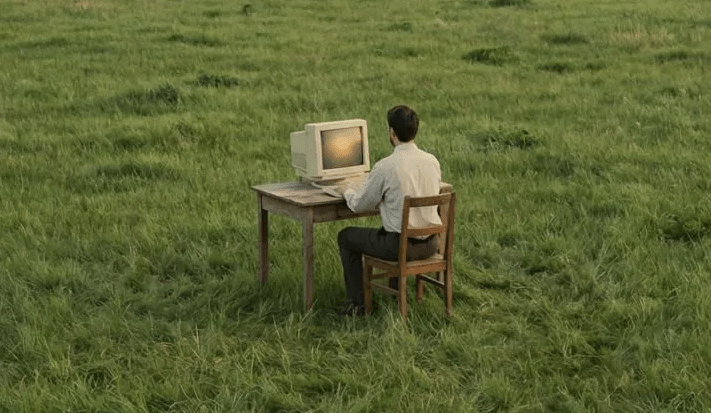
Earlier this week, a friend sent me an article about the death of blogs. Knowing this friend, sending me the article was either an attempt to bond over the fact that his Harvard CS PhD is now just as much as a vocational safety net as my measly BA (thanks, R–) or fear-monger me into a more grounded career path than ‘starving artist extraordinaire’ (once again, thanks, R—).
But I clicked on the link and pressed on. In the article, blogger Daniel Stanica launches into a 21-minute read documenting how he tracked the downfall of the 100 most once-successful blogs in the last four years: of them, only twenty-one saw growth, 20% of blogs lost 99% or more of their organic traffic, and 12% lost ALL of their traffic—read it again, ALL of their traffic—at the hands of AI-generated content and zero-click searches (AKA the “AI Mode” that pops up on Google, which makes it so users can get AI-summarized answers in a text box at the top of search results without having to click on any actual articles). The blogs that managed to survive seemed to do so out of a witch’s brew of personal branding, existing committed readership, and luck—and even then, there were only a few big fish in each category that managed to rise to the top of the AI-slop-infested waters.
It’s a grim picture, one that positions itself as inscrutable evidence that the death of the online writer is finally upon us. We are finally meeting the same harsh reality of the coders, customer service workers, and finance bros whose careers have been slowly phased out of the list of viable options for the human workforce. We managed to stay afloat on the backs of pen-and-paper sentimentalists for this long, but our optimism about our ability to write our way out of this one is coming to a full end-stop.
Or is it?
There are some fundamental problems with Stanica’s approach—problems that call into question not just the legitimacy of his claims, but also what the most adaptive response to the real problems he identifies actually looks like.
The problems:
- Gross traffic is used as a metric for a blog’s success rather than the attentional resources of dedicated readership.
- The research assumes that blogging remains the main platform for online writing.
- There is no data present for debut writers/bloggers who may be better adapted to optimizing SEO (and producing content that people are actually interested in) against a backdrop of AI.
I could put on my ex-STEM hat for a second and do a deep dive into why all of these reasons could have made the situation seem more dire than perhaps need be; attention, not site visitation, is the primary way writers convert one-time skimmers to lifetime readers; most online writers have moved to platforms like Substack where user bases are more concentrated and are already interested in consuming long-form content, which isn’t true of your average internet user looking for information; emergent writers in the field may be more indicative of rising market trends than the performance of old players; but explaining myself any further would distract from my main gripe with Stanica’s article: it is a 21-minute read on a blog I’ve never heard of. I’m bored.
This, of course, is the exact problem Stanica is diagnosing. “Internet user” is no longer synonymous with “reader.” The core audience of the blog-o-sphere has shifted from information-seekers to community-seekers, and the market is not adapting to this change.
Maybe I’m just going into AI psychosis, but as I read the article (and as “Write with Gemini” shows up in tiny gray letters on this Google Doc), I’ve noticed that my knee-jerk, ivory-tower-enforced disgust towards AI has softened. My heart rate accelerates as I come to the horrible, terrible, realization:
AI is going to be part of my future as a writer, and I am ready for it.
Online writing isn’t dying. It’s changing. And while that change is being catalyzed by AI, that doesn’t mean we should all give up on writing forever. It means we need to pivot from and revise what’s worked in the past.
There is a false dichotomy that many non-writers fall into when they think about AI use in content creation: robot slop or hand-spun gold. This is not the reality we face.
Human writing can be bad. Most is. Writing skills are not something that are fixed; they are developed over a lifetime of practice and commitment. What makes a good writer has never been writing abilities—it’s caring enough about the craft to show up despite not being “good enough.” It’s wanting to spread your ideas with such fervor that you don’t care if your words aren’t perfect, you just know that they need to get on the page.
But I want to be clear: I’m not saying that a body of readers who legitimately care enough about creativity for the sake of it will come rushing out of hiding to save the modern writer. We are not living in a society of aesthetes, and it would be too naive for even me (in all my hyperoptimism) to make that claim. The “my audience will find me” mindset not only lives in delusion about the degree to which modern readers appreciate “fine art” (which, hate to break it to you, your unstructured braindump about your situationship probably isn’t), but it also feeds into the belief that human writing is inherently better than AI-generated content.
AI-generated writing is not worse than human writing. To believe otherwise is not just wishful, but blatantly false. Neither one is better or worse than the other, they are only more or less appropriate for a given set of demands; they fulfill different purposes. AI-generated writing is good for information synthesis, research, and logic-based appeals, while human writing is good for understanding lived experiences, producing art, and connecting with others. There are many good traits of both modes when used purposefully.
Which (finally) brings me to my main point:
BAD WRITERS ARE GOING TO WIN THE GAME.
Or, at least, no longer be considered “bad.”
A key insight Stanica derives from his data is that the blogs most likely to survive and thrive were based in what we can call “humanistic” niches, those being content categories that require creators to bring lived experience and human expertise to their writing rather than just summarizable information. For human-created content, the personal and messy beat out polished, well-researched facts—and that’s the direction we’re going to continue to move in.
Regardless of how you feel about the fall of technically “good” writing, I see the shift away from copy and informational prose as a boon to creativity. AI wiping out the relevance of human-created fact-based writing means people need to be more authentic in creative spaces in order to succeed. They need to represent their lived experiences as truthfully as possible because their experiences are the most valuable asset they have. Writers need time to live their lives in order to write about them, and market changes driven by AI-generated writing provides them with that opportunity.
It’s not just market changes that have the potential to facilitate more creative, authentic expression, though: ironically, using AI as part of the writing process may also free up the cognitive resources needed to produce generative creative work. What most people don’t know about writing is that it is more than translating experience to words. There is a hidden logistical underbelly to every book you keep on your bedside table. Hours upon hours of preparing pitch documents, researching agents, parsing through contracts (plus brushing up on contract law), publicity, and marketing strategy are only a few examples of the behind-the-scenes work that goes into producing a full-length book. For smaller publications like Substack, there’s still the work of creating an email list, strategizing content development, and promoting content via other channels; all this on top of the work of actually getting the words written. Being a writer is undeniably a full-time job—yet, we’re often treated as lackadaisical “free spirits” who just so happen to enjoy clacking at their keyboard in their free time. And while that may be true for some writers, the more common case for serious writers is intense burnout with very little payoff.
Writing is a grueling business that runs on the fumes of passion. Using AI as a writer to manage the tedious backend outputs of the job—like any smart business owner would do—is not a weakness, it’s an adaptation.
This brings me back to my initial question: What does the future look like for writers who don’t use AI?
Writers who use AI to produce their final work will no doubt be left in the dust. People are getting better at recognizing when something is written by AI, and, frankly, they don’t put up with it. We keep scrolling when we are suspicious that a human story could have been fabricated by AI and scoff at the notion of AI-generated books. We aren’t looking for an engine to replace human words—we’re looking for human words that make us care about them.
But notice: My title does not ask what the future looks like for writers who write with AI, but rather writers who use AI. Purposeful AI use can be constructive, even beneficial to players who know how to set firm boundaries around it. The most likely picture for someone who cuts AI out of their writing career entirely? A burnt out, exhausted shell of a creative who spends so much time being upset over their lack of readership and the ingratiation of technology into daily life that they physically cannot produce creative work. Ironically, by rejecting AI flat-out, they get caught in another sort of AI bubble: the anti-tech echo chamber. There’s an audience there, sure, but it seems to me unnecessary at best and mentally debilitating at worst to live your days thinking about how much you hate the system you’re entrenched in only to spend your nights writing about it. It’s not a life I want to live, anyways.
That being said, acquiescence is not the answer, either—it’s independence. Choosing when and where to use AI in a creative life that you choose how you live: that’s the real reward to be gained here. AI use doesn’t have to be so black-and-white as either selling your soul to the tech giants or cutting automation out completely. Intentional, purposeful AI use can empower writers. Especially for small writers who don’t have the budget to spend tens of thousands of dollars hiring marketing or PR agents (as most publishing companies expect their writers to do), AI can take off some of the weight off the logistics of writing and give working writers the space to think that need to produce work representative of their experiences—work people actually want to read, that can actually make a difference in people’s lives.
AI is an indirect gateway to creative discovery for those who know how to use it right. If you can use AI to carve out enough room in your life to live it to the fullest instead of getting bogged down by logistics that, mind you, no one else is taking the trouble to deal with, you place yourself at a strategic advantage that may allow you to live more independently, and more creatively, than ever.
Research agents, send out your query letters, SEO-maxx your titles, research the channels where your target audience is spending the majority of their time, I don’t care; but whatever you use AI for in service of your writing career, make sure the degree of optimization you’re doing it with supports your creativity to the nth degree. Integrating technology into creative work is going to be the future of how we advance in the writing field, a field which is already…dynamic, let’s call it. Teaser for next week, if ya nasty.


Leave a Reply