One of my favorite parts of the postgrad experience has been watching my peers come into themselves on social media, oftentimes into people I would never expect. It fills me with joy to see the girl I had petty beef with sophomore year put “RN” next to her name on LinkedIn and to see wedding announcements on my feed (my jaw drops every time). It makes me feel like my world is expanding, like I’m seeing what possibilities are out there now that we’re ‘real adults’ and all that.
All this expansion has led to me taking life more seriously—not just in terms of aspirations and “adulting,” but also by giving credit to the potential for serious joy that’s to be found in the way that we live. By “serious joy,” I don’t mean the “deeper,” more sober joy that’s typically associated with growing up (the whole nuclear family life? not my vibe), but rather the sheer weightiness of joy as a feeling.

So often we categorize genuinely enjoying our activities as a benefit of living a balanced life, but it’s actually a necessary foundation of that life. Joy not only deserves to be taken more seriously in our daily lives; it needs to, for the sake of our quality of life. In the short term, joy is an escape for our have-to’s in favor of exploring our passions; in the long-term, experiencing joy works in a positive feedback loop by calibrating your intuition to seek it more, which means you’re more likely to integrate it into your future plans and goals. Joy begets joy. (Keep the sentiment in your back pocket. We’ll need it later.)
As I’ve started taking the world more seriously, I’ve also started taking myself more seriously. I take the time to wonder: Who is the person I’ve grown into? What do old friends think of me when they run into me in the grocery store? Would they all gasp and turn away like K. did? Would they all wear their disappointment in me on their sleeve so bluntly?
On a scale from 1-10, how obvious is it?
(no hesitation) 10.

During college, it’s easy to forget you’re changing because there’s always another identity to cling to. You’re not “the kind of person who burns herself out,” you’re a “hardworking True Bruin.” Not a stoner, just someone who smoked wayyyy too much in college. Not struggling, just getting through. There’s always another life to escape into: the transience of being a college kid. And even though college may have put the real world on hold for a while, provided me a little bubble to self-destruct in, it’s over now. It’s time to look in the mirror.
Mirror-looking (both literal and metaphorical) has always been an activity I was reprimanded for. When I was a teenager, it was far too vain; a college student, a wasted second that could be better spent on my studies; and an eating disorder patient, a behavior. All of this shame-be-to-the-mirrors sentiment makes sense, especially given my diagnoses. My therapist didn’t want me ruminating just as much as my dietitian didn’t want me to see my body. But we are embodied and embedded beings. In other words, we experience the world by existing in it, and it shapes us just as much as we shape it. A crucial part of the cycle of existing, experiencing, and changing is reflexivity: being able to look back on yourself and form judgments based on what you see. You can’t know where you’re going if you don’t know where you are to begin with.
We will change whether we like it or not. Being willing to look in the mirror and objectively assess where you’re at is what gives you control over what that change will look like.
What do you think other people say when they see you with me?
Why.

Going back to San Diego from New York feels like an episode of “The Twilight Zone”: without everyone in the city out and about every hour of the day, public spaces are eerie. There are many a time I stop and literally shout in the middle of an empty sidewalk just to see if my voice will echo off the streets (it doesn’t). Home is now an unwilling default—no longer a place of youthful respite (especially not since moving in with my mother), but rather one of entrapment. Out in public is too quiet for comfort, but at least there are still pockets of distractions from my mental mirror-looking in groups of teenagers out on town, couples picnicking in the park, baristas rolling their eyes over having to make another lavender matcha. These moments are endearing distractions from the realization that hits me every day when I walk in the front door to my childhood home: I’ve changed.
Yes, I’ve changed since New York. Since college. Since forever. I swapped reading with high walks in the wee hours, café small talk with locking in at my desk at home, ravenous sentimentalism with…nothing. Without the protection of a label to hide behind (“student,” “intern”), I am faced with a challenge: to reinvent myself with the scraps I left behind, decide what my “normal adult life” will look like. There is no more writing off my bad habits on being “just a kid.” And I can’t keep up those habits any more because they will reduce my quality of life down the line—going broke, starving, overdosing—and I can’t let myself waste my time any longer. I have to change the person I’m becoming while I’m still becoming her.
I don’t know. Curiosity?
No. Not “why” like “why?” I think they think, “Why?”

You learn a lot about yourself living alone. You realize your habits control who you are and how you show up in the world. You realize that the dishes won’t get done if you hurry off one hasty morning, that no one else is going to clean up the common space but you. But the worst realization that comes from seeing that sink full of rotting food? You were the one who left them there. There is no one else to blame.
Bearing the sole brunt of the responsibility for your actions…woof. It’s a heavy load, but one that’s surprisingly freeing. A. told me he assumed other people scoffed when they saw him in public with me, wondered what a guy like him would be doing out with a girl so decrepit. It was and remains one of the meanest, most honest things anyone has ever said to me. I didn’t feel its impact at the moment, but now the words make my knees quiver under its weight. They make me realize that I’m real. I am perceived by others, and I don’t get to control what they think of me. It’s some frustrating shit, but it ain’t bull.
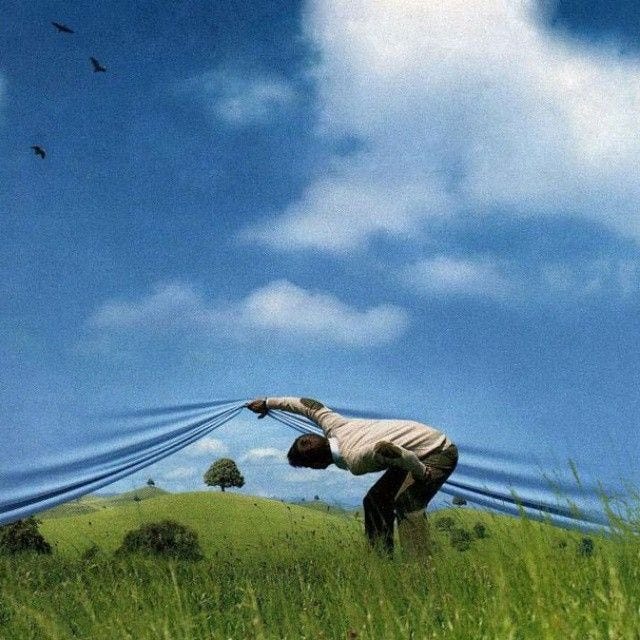
Lately, I’ve been countering this not-bull shit by focusing on showing up and acting better so that I have to experience this weight less. We don’t get to control what others think of us, but we can at least try to influence their perceptions by making our outside activities match our authentic internal desires. People respect people who act in line with their long-term goals and values. They’re seen as more trustworthy and as having more integrity, someone who actively improves the lives of those around them. The burden of others’ judgments doesn’t go away entirely when I start using my time wisely and being proud of how I spend it, but it does make me strong enough to bear the weight. More intentional living has made me fiery with passion, passion that gives me enough fortitude to scream over my internal voices. By living daily with the end in mind, I’ve been able to muster the courage to shrug off the boulder of external judgments.
Blink once, twice…could it be? Sisyphus, happy? At last!

 FREED VERSE
Leave a comment